Pro-curo tracks every biological sample your laboratory holds: what it is, where it is, what condition it is in, and who has handled it. Barcode-driven, fully audited, and designed around the traceability duties of the Human Tissue Act and the EU Tissue Directive.
Most laboratories start with a freezer spreadsheet and a paper log. It works until the day it does not: a sample cannot be found, a location column was never updated, two people edited different copies, or an inspector asks for the custody history of a sample from six years ago.
A box gets moved, the spreadsheet does not. The sample exists somewhere in the freezer farm, but the record no longer tells you where, and someone loses an afternoon to a manual search.
Paper logs record that a sample left storage but rarely who returned it, when, or in what condition. Reconstructing that history after the fact is slow and rarely convincing.
Evidencing donor-to-recipient traceability from spreadsheets means assembling the trail by hand, for every sample the inspector picks, under time pressure.
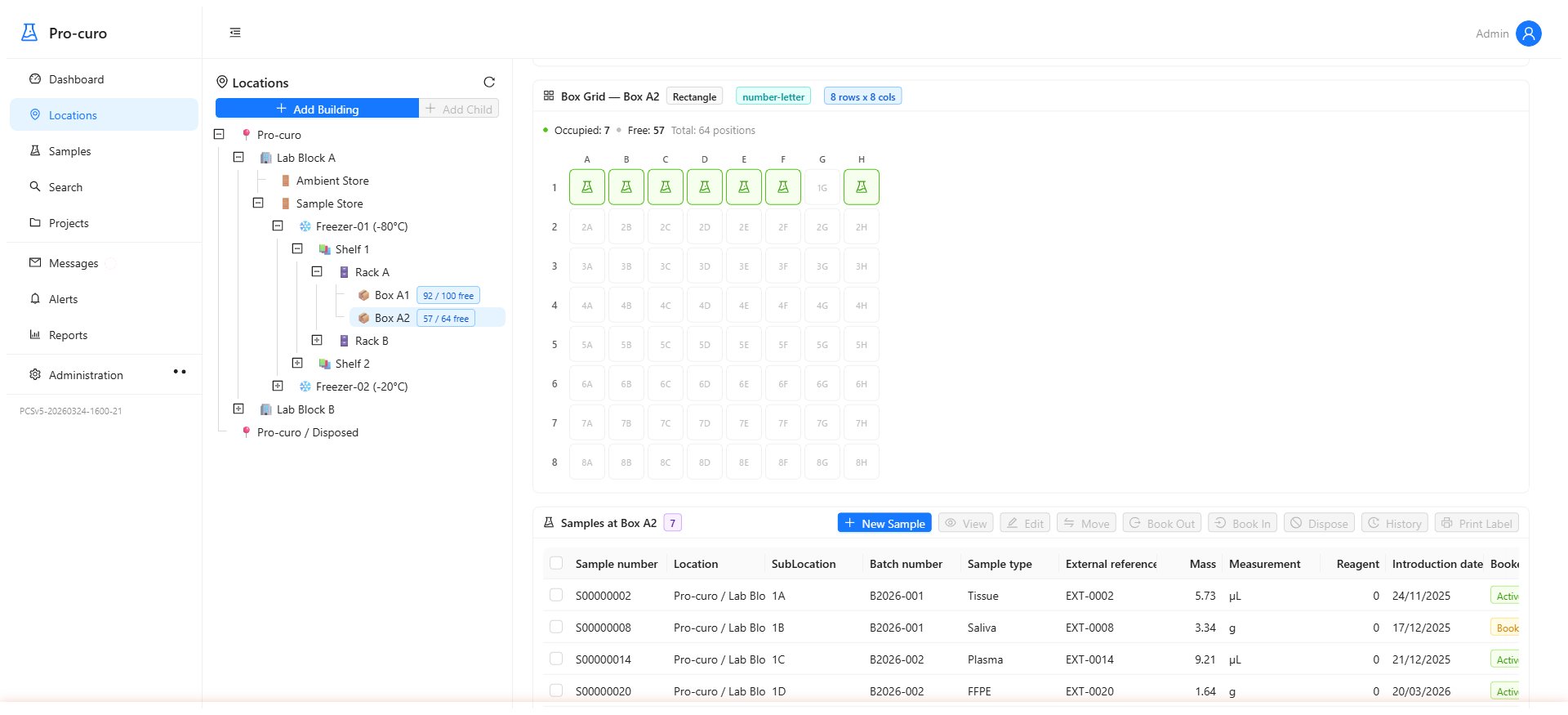
Register a sample once and Pro-curo carries it through its whole life: intake, storage, movement between locations, aliquoting, issue, and disposal. Scan a barcode and you see the sample's current location, its linked project and documents, and every event in its history.
Read our white paper: The Importance of Sample Tracking in Life Science Laboratories
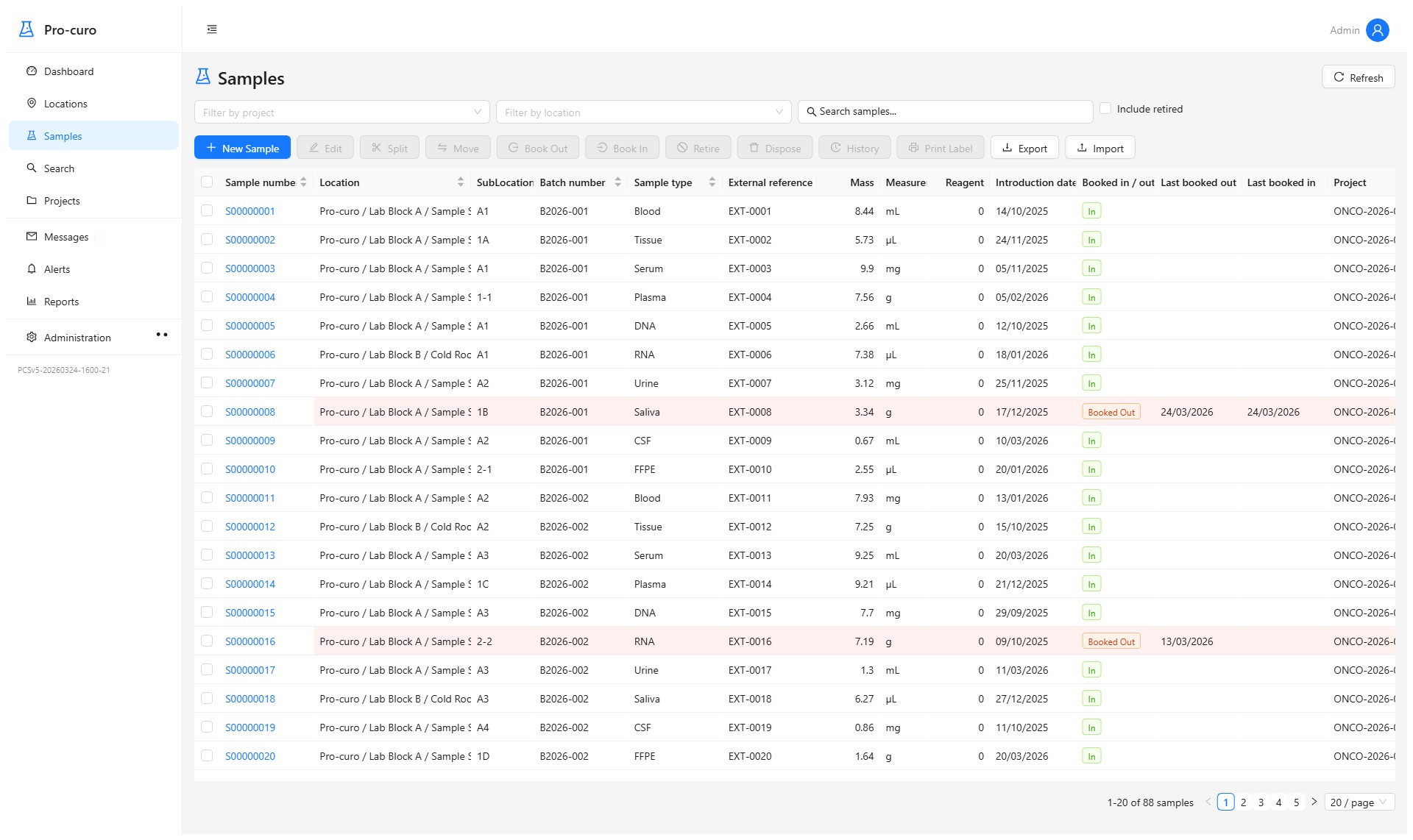
Every change is logged: who did it, when, and what the previous value was. Because the audit trail is a by-product of normal work rather than a separate paper exercise, the custody record is complete by default and can be produced on demand.
Read our white paper: Chain of Custody in the Laboratory
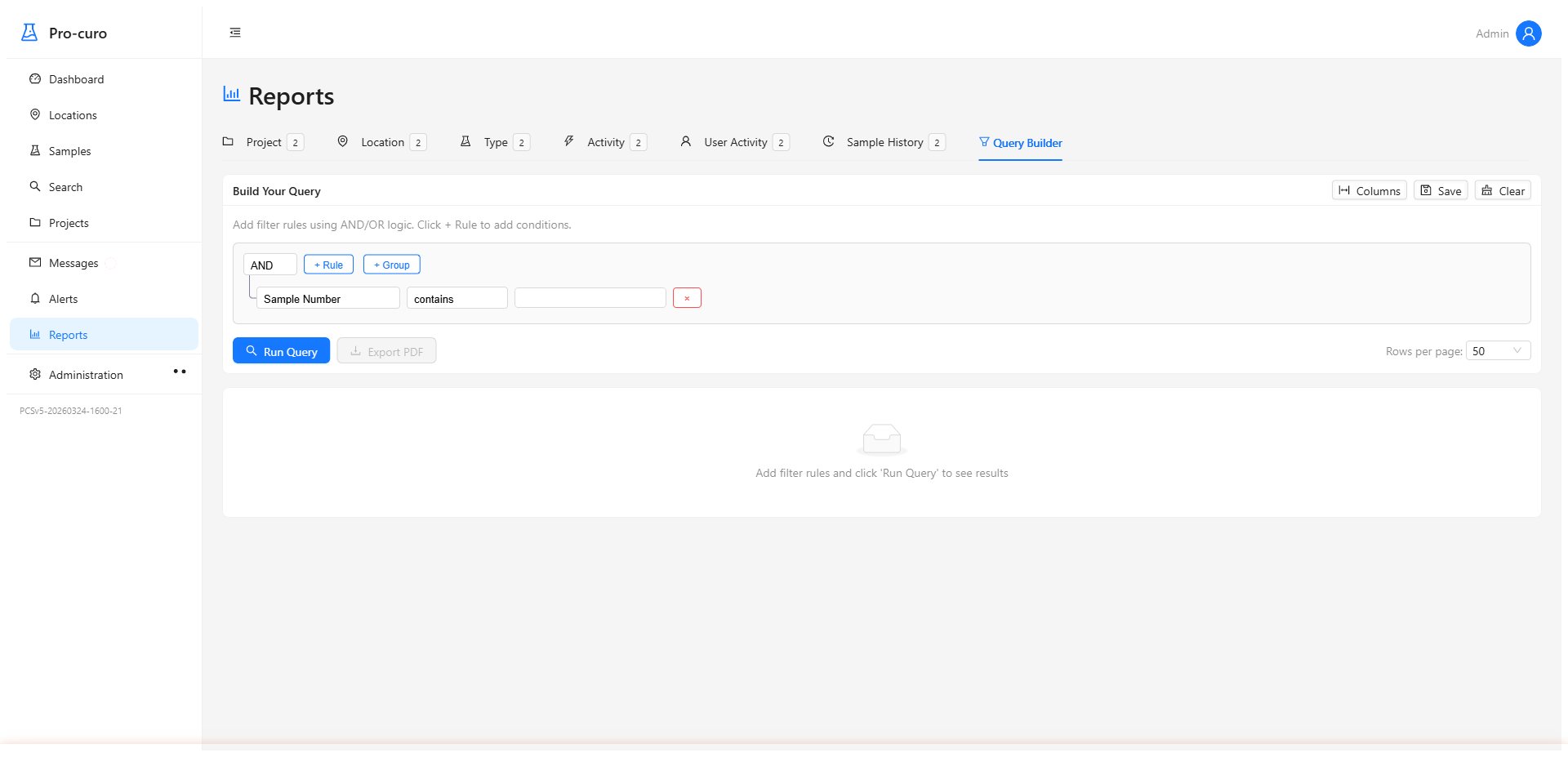
The visual query builder lets your team filter, group and sort sample data without writing code, then export to CSV or produce a PDF report. Saved queries turn a recurring inspection or management question into a two-click answer.
Pro-curo is used by organisations whose duty of care over physical samples is the core of their operation, not a side effect of it.
Licensed establishments needing donor-to-recipient traceability and records that satisfy the Human Tissue Act and EU Tissue Directive at inspection.
Clinical laboratories tracking human material across departments and sites, where information governance often means on-premise deployment.
Research groups managing biobanks and study collections, where samples outlive the researchers who collected them and the record has to survive staff turnover.
If your establishment is licensed, sample tracking is not an efficiency project, it is a licence condition. These guides explain what the regulations actually require and how an electronic system evidences it.
What Directive 2004/23/EC and its implementing directives require on coding, traceability and reporting, and how UK law applies them.
Read the guideHow the Human Tissue Act 2004 and the HTA licensing framework shape traceability duties for tissue establishments.
Read the guideWhat changes, what to plan for, and how to migrate an existing paper or spreadsheet sample record without losing history.
Read the guideIt records the identity, location, condition and custody of every biological sample you hold, from arrival to disposal. It replaces spreadsheets and paper freezer logs with one searchable record, and keeps an audit trail of who handled each sample and when.
A full LIMS is built around test workflows and instrument results, and can be large and costly to configure. Sample tracking concentrates on custody, location and traceability of the physical sample, so it is faster to deploy and easier to validate.
Yes. Both require donor-to-recipient traceability and records kept for decades. A full audit trail lets you evidence that traceability at inspection in minutes rather than reconstructing it from paper.
Pro-curo prints to virtually any label printer using your choice of labelling software and templates, including Brady, Zebra, SATO, Honeywell, TSC, Toshiba and Domino. Existing validated templates can be reused. V5 also has its own built-in label designer, printing labels as a PDF through your label printer's Windows driver, so you can start printing without any separate label software.
Yes, cloud-hosted or on-premise, and you can move between the two later. On-premise is common where information governance requires sample data to stay inside your network.
The CSV import wizard maps your existing columns to Pro-curo fields and validates the data before import, so a freezer spreadsheet becomes a structured sample record. Onboarding and migration support are included.
We run demos using your own data, so you can see exactly how your collection would look and how your team would work day to day.
Request a Demo